


This course is available with a live instructor
onsite or through a virtual platform.
CubeSats enable organizations big and small to achieve their space ambitions. But to be successful, cubesats still require disciplined, but tailored, systems engineering. Most cubesat mission challenges happen at the interfaces—where hardware, software, operations, and schedule collide. The Integrated CubeSat Engineering Workshop (ICEW) let’s you confront those integration decisions before they become real problems.
Using a detailed, threaded case study for context, you work hands-on with a fully-functional 3U desktop cubesat system that demonstrates real spacecraft bus and payload functions, as well as integration and operations challenges. The workshop follows the typical lifecycle of a CubeSat mission—from early concept through design, integration, verification, and operations. Systems engineering tools and MBSE concepts are introduced to illustrate how they can
strengthen clarity, traceability, and disciplined execution.
As the mission evolves throughout the course, you will confront the same trade-offs real projects face: architecture choices, orbit and launch constraints, subsystem interactions, verification planning, and operational readiness.
Thinking about starting your first cubesat project? Preparing a CubeSat team for credible delivery and operations? ICEW is designed for systems engineers, project managers, and integrated product teams who need practical experience turning designs into operable space systems.
At the end of this course you will be able to:
✦ Define mission needs, goals, objectives and ConOps for a CubeSat mission to satisfy Pre-Phase A requirements
✦ Develop and organize detailed mission and system requirements as required by a Phase A System Requirements Review (SRR)
✦ Describe the tools and techniques needed to develop the complete preliminary design for a CubeSat and conduct a Phase B Preliminary Design Review (PDR)
✦ Evaluate the typical products produced for a Critical Design Review (CDR) at the end of Phase D including system specifications and test plans
✦ Implement a typical assembly, integration, and test plan for a representative CubeSat system to apply the flow down from requirements to verification activities
✦ Conduct simulated operations using a representative CubeSat system to develop and apply operational planning and procedures implementation
✦ Apply Model-Based Systems Engineering (MBSE) to each phase of a project lifecycle
✦ Enter any phase of the space mission lifecycle and apply course principles to achieve practical results
✦ NanoMET-2 Case Study
✦ Conceptual CubeSat Mission Design Fundamentals
• CubeSat Mission Essentials
• Applied Space Systems Engineering
• Planning for Launch/Space Environments
• Launch System Services
✦ Introduction to Model-based Systems Engineering
• NanoMET-2 MCR*
✦ CubeSat Mission Preliminary Design
• System, Orbit Design
• NanoMET-2 SRR and other Exercises
✦ CubeSat Mission Critical Design
• Spacecraft Architecture Development
• Subsystem Design
• Fundamentals of Flight Software Engineering
• Introduction to Electronic and Mechanical Design
• NanoMET-2 PDR/CDR and other Exercises
✦ CubeSat AIT, Launch and Checkout
• Space System Verification and Validation
• NanoMET-2 SIR
• NanoMET Assembly, Integration and Verification Exercise
✦ CubeSat Mission Operations
* Guided Hands-on Exercises
Each participant will receive:
• A complete set of course notes with copies of all slides used in the presentation
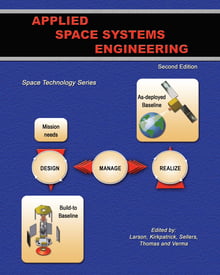
• An e-copy of the Applied Space Systems Engineering textbook
Digital badges are web-enabled versions of a credential or certification which can be verified online.
Click here
for eligibility and request process.