
This course is available with a live instructor onsite or through a virtual platform.
This course is also available on-demand, working at your own pace.
The Why, What and How of Space Missions and Systems
Space is hard. Getting into space, operating and delivering essential space services such as communication and remote sensing requires a complex orchestration of physics, technology, people, processes and things. Missions sometimes fail when early assumptions go unchallenged, constraints are misunderstood, or decisions are made without a clear picture of how things actually work (or don’t) in space. Understanding Space gives you the knowledge, insight and context to manage this complexity and better contribute to the space enterprise.
This course frames your understanding of space around missions, orbits and systems to learn how fundamental space concepts influence success or failure. Throughout the course, you’ll explore why we use space, how the space environment and orbital mechanics enable and constrain what we can and can’t do. Examine how space payloads, human spaceflight, spacecraft subsystems rocket science, and launch vehicles work in real missions. Gain an appreciation for how technical decisions throughout a project are interconnected. Hands-on exercises build capability and confidence that you can apply directly to actual programs.
New to space? Finding the jargon, constraints, and decisions hard to connect? Understanding Space helps you see the big picture quickly—without getting lost in technical detail. It’s designed for newcomers, cross-disciplinary engineers and managers, and experienced practitioners looking to reconnect fundamentals to real mission outcomes, whether you’re contributing to early studies, reviewing designs, or supporting missions already in operation.
Onsite/virtual: 2–3 days
On-demand self-paced (asynchronous): Includes 24 self-paced lessons with videos and quizzes, taking most students 24–35 hours to complete. Access lasts 120 days.
At the end of this course you will be able to:
✦ Gain Core Space Knowledge
• Define and describe important astronautics terms and concepts
✦ Comprehend Space Mission Capabilities, Trade-offs and Limitations
• Explain how and why space is used to provide capabilities on Earth
✦ Apply Space Concepts to Real-World Problems
• Calculate basic orbit and system parameters that drive mission scope and cost
✦ Analyze Typical Space Problems
• Compare and contrast different technical approaches for space missions
✦ Synthesize Concepts to Design a Space Mission
• Design a space mission given basic goals and objectives, and develop a top-level project plan
✦ Evaluate Basic Technical and Programmatic Space Issues
• Assess the technical merits of various space mission architectures
✦ Space in Our Lives
• Space in Our Lives
• Elements of a Space Mission
• A Brief History of Space
• The Space Enterprise
• Space Systems Engineering
• Mission Management & Space Operations
• Down to Earth Issues Exploring Space
✦ Orbits & Trajectories
• The Space Environment
• Understanding Orbits
• Describing & Using Orbits
• Orbit Design
• Orbit Maneuvering
• Ascent and Re-entry
✦ Space Systems
• Payload and Spacecraft Design
• Human Spaceflight
• Spacecraft Subsystems
• Rocket Science
• Launch Vehicles
Each participant will receive:
• A complete set of course notes with copies of all presentation slides
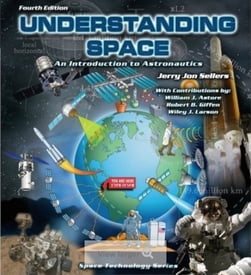
• An e-copy of Understanding Space: An Introduction to Astronautics (not included with online course)
Digital badges are web-enabled versions of a credential or certification which can be verified online. Click here for eligibility and request process.