

This course is available with a live instructor
onsite or through a virtual platform.
Model-based Systems Engineering can empower teams to work smarter. Unfortunately, teams can sometimes get lost in the complexity of the tools, and lose sight of the objective—capturing and communicating key system information to stakeholders. Diagrams can multiply, but clarity and insight doesn’t come automatically. Applied MBSE (AMBSE) helps you harness the capability of MBSE tools by helping you hone practical skills for building and using system
models to deliver real project value.
This course treats MBSE as an integrated engineering communication discipline. Rather than merely teaching how to drive a specific tool, AMBSE focuses on how to abstract real-world systems into purposeful models that improve clarity, consistency, traceability, and engineering judgment—principles that apply across tools and projects. While the approach is tool-agnostic, participants gain extensive hands-on experience using either Innoslate or Cameo, with other
tools accommodated by arrangement. Emphasis is on learning how MBSE can be used throughout the lifecycle: capturing and validating design requirements, communicating solution architectures, connecting interfaces and tracing verification activities.
You will learn by doing. Through a progressively more complex series of exercises, you will demonstrate MBSE’s core advantages—capturing, connecting, controlling, communicating, collaborating, and cycling. Starting by creating the model for a simple system by following a detailed guided set of procedures, you’ll build on that knowledge and skill to develop and execute models for more complex systems, culminating in the creation of your own model from scratch.
Have an MBSE tool but not sure where to start? Are you expected to build or maintain models that actually support engineering work? AMBSE is designed for systems engineers and technical team members who need hands-on experience using models as active engineering assets.
At the end of this course you will be able to:
✦ Define model-based systems engineering and discuss its value proposition across the project lifecycle.
✦ Recognize and explain the use of SysML as well as other commonly used systems engineering diagrams and artifacts.
✦ Given existing system details, apply MBSE tools and techniques to build a basic system model that captures and communicates the design solution as well as key relationships.
✦ Use a system model to simulate system behavior.
✦ Using MBSE, examine details about a system’s structure and behavior to identify potential issues (i.e. gaps, omissions, overlaps, missing traceability, cause and effect, etc.) and propose fixes or improvements to the model.
✦ Model specific systems engineering artifacts such as requirements, functional architectures, and interface architectures using diagrams and other techniques across the Design, Manage and Realize lifecycle.
✦ Build your own integrated model
✦ Foundations
• Introduction to Systems Engineering using Models
• Innoslate/Cameo Quick Start Guides
• Ontologies, Languages and Frameworks
• Solar Fan Exercise
✦ MBSE Applications
• Design—Expectations, ConOps, Requirements, Solution Architectures
• Manage—Requirements, Interfaces
• Realize—V&V planning
✦ MBSE Creation
• Introduction to MBSE Simulations
• Design Patterns and Model Re-use
• Software Modeling
• Project and Configuration Management
• Digital Threads and Digital Twins
• Tool Selection Exercise
• Building Your Own Model
• Model Building “Graduation” Exercise
Each participant will receive:
• A complete set of course notes with copies of all slides used in the presentations
• An e-copy of the Applied Space Systems Engineering textbook
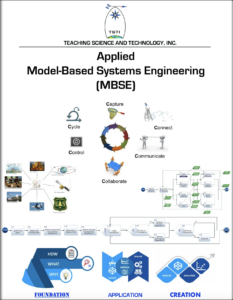
Sample Handout – coming soon!
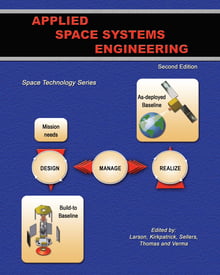
Course Textbook
Digital badges are web-enabled versions of a credential or certification which can be verified online.
Click here
for eligibility and request process.