


This course is available with a live instructor
onsite or through a virtual platform.
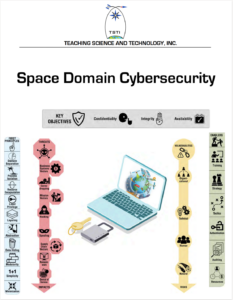
Cybersecurity defines space mission resilience. A weakness in the enterprise, development pipeline, system design, or operations can compromise an entire mission long before launch. The Space Domain Cybersecurity (SDC) course equips you to critically evaluate cyber risk across the full space enterprise—before those risks become mission-ending events.
Cybersecurity in the space domain does not live in a single system or network. It emerges from the interaction of people, processes, technologies, and operations across enterprise, mission, system, and DevSecOps layers. This course focuses on the decisions that determine how cyber risk is introduced, propagated, mitigated, or ignored—and how those decisions affect mission resilience and success.
The course is organized around the SPAce Domain Cybersecurity (SpaDoCs) Framework, a structured model for analyzing cybersecurity as a mission-level concern. You’ll begin with core cybersecurity fundamentals and the objectives of confidentiality, integrity, and availability, then apply them systematically across each space-domain layer. Emphasis is placed on understanding how threats and vulnerabilities manifest differently at each level and how
weaknesses can cascade across the mission.
Table-top exercises introduce realistic mission scenarios to analyze threats, assess vulnerabilities, and challenge you to evaluate trade-offs between security, performance, cost, and operational complexity. These experiences reinforce cybersecurity as a decision-support discipline, not simply a compliance exercise.
Understand cybersecurity but new to the space domain? Understand space but new to the challenges of cybersecurity? Are you responsible for cybersecurity decisions that affect space mission success? This course is designed for cybersecurity professionals seeking to understand the space domain, and space professionals integrating cybersecurity into mission and system contexts.
At the end of this course you will be able to:
✦ Space Domain Cybersecurity Fundamentals
• Describe the big picture challenges of cybersecurity in the space domain as organized in the Space Domain Cybersecurity (SpaDoCs) Framework
• List and define key objectives of cybersecurity (CIA Triad), the first principles of secure systems, along with cybersecurity enablers
• Identify cyber threats to and vulnerabilities of space missions and systems
• Characterize the various layers of the space domain and the elements that comprise them
✦ Cybersecurity Principles
• Apply cybersecurity first principles to specific space domain threats and vulnerabilities
• Associate specific cybersecurity enablers with various space domain threat or vulnerability scenarios
✦ Cybersecurity Threats and Vulnerabilities
• Analyze threats and vulnerabilities and their attack vectors for various space domain scenarios at each layer
✦ Cybersecurity Design Implementation
• Apply cybersecurity design principles to a space system architecture
✦ Course Intro
• Course Objectives
• Framework Overview
✦ Cybersecurity Fundamentals
• Space Domain Layers
• Enterprise Layer
• Mission Layer
• System Layer
• DevOps Layer
✦ Threats and Vulnerabilities
• First Principles of cybersecurity applied in the space domain
• Enablers of security and mission success in space enterprises
Each participant will receive:
• A complete set of course notes with copies of all slides used in the presentations
Digital badges are web-enabled versions of a credential or certification which can be verified online.
Click here
for eligibility and request process.